
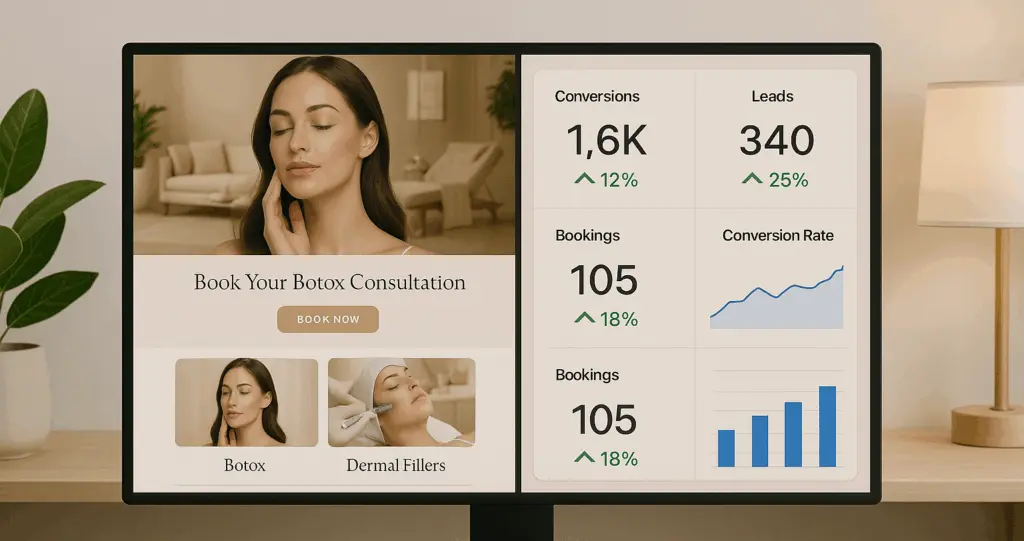
Facebook ads for med spas can fill a treatment calendar fast, but only when the ad, offer, and follow-up work as one system. Most clinics we audit get plenty of clicks and very few booked consultations.
In this guide, we break down the exact process we use to turn ad spend into scheduled appointments. It covers offers, targeting, creatives, follow-up, and the numbers that matter.
Why Facebook Ads for Med Spas Work When Done Right
Med spa services are visual, personal, and often an impulse-plus-research purchase. A person scrolling in the evening sees a result that matches what they want, then spends a few days deciding. Facebook ads for med spas work because they reach people during that consideration window, before they start comparing clinics on search.
The problem is that most campaigns stop at the lead. We have seen firsthand that a form submission means nothing until the patient is sitting in the treatment chair. That is why every campaign we run is measured by booked and attended consultations, not cost per click.
The first piece of that system is the offer itself.
Build Offers Patients Actually Book
Your offer decides who responds. A vague “Book a consultation today” ad attracts almost nobody, while a heavily discounted offer attracts bargain hunters who rarely return.
We prioritize offers that lower the barrier without cheapening the brand:
- Complimentary skin or aesthetic assessment with a credit toward the first treatment
- New-patient packages for services like laser hair removal or facials, priced as a series
- Limited monthly availability for a specific treatment, stated honestly
- Membership introductions that turn a first visit into recurring revenue
We always advise clients to choose one core treatment per campaign. When an ad promotes Botox, fillers, facials, and body contouring together, the message gets diluted, and so does the lead quality.
Once the offer is set, the next step is putting it in front of the right people.
Targeting the Right Patients With Facebook Ads for Med Spas
Targeting for med spas starts with geography. Most patients will not travel more than 20 to 30 minutes for aesthetic treatments, so we set a tight radius around the clinic and exclude areas that historically produce no-shows.
Beyond location, our approach follows three layers:
- Broad audiences with strong creative. Meta’s algorithm now finds buyers more effectively when the ad itself signals who it is for.
- Retargeting. Past website visitors, video viewers, and people who opened a lead form but did not submit it.
- Past patient lists. Uploaded customer lists used for exclusions or reactivation offers.
Keep in mind that Meta restricts some health-related targeting options. That makes your creative and offer more important than any interest selection.
Ad Creatives That Earn Trust and Stay Compliant
In aesthetics, trust drives the booking decision. Polished stock images look like every other clinic. Real photos of your treatment room, your injector, and your front desk perform better because they show patients exactly where they are going.
The formats we rely on most:
- Short provider videos explaining what a treatment feels like and how long results last
- Patient testimonial videos, with written consent
- Treatment walkthroughs that remove fear of the unknown
Compliance matters here. Meta’s advertising policies prohibit ad copy that implies a viewer’s personal attributes. A line like “Tired of your wrinkles?” can get an ad rejected. We write copy that describes the treatment and its outcome instead of the viewer’s appearance. Before-and-after images face strict review, so we always check the current policy before a campaign goes live.
Great creative gets the click. What happens after the click decides the booking.
Landing Page or Instant Lead Form: Which to Use
Facebook offers instant lead forms that open inside the app, and they produce leads cheaply. They also produce more low-intent leads because submitting takes two taps.
Here is how we decide:
- Instant forms work well for lower-priced offers and high-volume services, as long as we add a qualifying question such as preferred treatment or budget range.
- Landing pages work better for premium treatments, where patients need to see pricing context, provider credentials, and reviews before committing.
Every landing page we build has one action: book or call. No extra menus and no competing links. The page must also load quickly on mobile, since nearly all Facebook traffic comes from phones.
Speed to Lead: Where Most Med Spa Campaigns Fail
This is the part most clinics underestimate. A lead who submits a form at 8 p.m. and hears nothing until the next afternoon has often already booked somewhere else.
We have seen firsthand that response speed changes results more than any ad tweak. Our follow-up system includes:
- An instant text and email confirming the request, even after hours
- A call from the front desk within minutes during business hours
- A follow-up sequence of texts over several days for leads who do not answer
- Appointment reminders 24 hours and 2 hours before the visit to reduce no-shows
Without this layer, even well-built Facebook ads for med spas will look like they are failing when the real leak is in the follow-up.
What to Budget and Which Numbers to Track
A local med spa can start testing with $30 to $50 per day. That gives the algorithm enough data within the first two to three weeks to show which ads and audiences produce real bookings. Clinics in competitive metro areas usually need more.
Track these numbers weekly, in this order:
| Metric | What It Tells You |
|---|---|
| Cost per lead | Whether the ad and offer attract interest |
| Lead-to-booking rate | Whether follow-up is working |
| Show rate | Whether reminders and lead quality hold up |
| Cost per booked consultation | The true acquisition cost |
| Revenue per new patient | Whether the campaign is profitable |
A low cost per lead with a poor booking rate points to a follow-up or lead quality problem, not an ad problem.
Common Mistakes With Facebook Ads for Med Spas
After auditing many aesthetic ad accounts, we see the same mistakes repeatedly:
- Promoting too many treatments in one campaign
- Running deep discounts that attract one-time buyers
- Using stock imagery instead of the real clinic and team
- Ignoring leads that do not answer the first call
- Judging performance by likes and clicks instead of booked appointments
- Changing ads every few days before the algorithm collects enough data
Fixing these alone often improves results without increasing spend.
Conclusion
Facebook ads for med spas deliver consistent consultations when the offer, creative, targeting, and follow-up work together. The ad is only the first step, and the booking is the real goal. Start with one treatment, respond to leads fast, and measure cost per booked consultation. That is how ad spend becomes predictable patient growth.
Why Choose Us
We build complete patient acquisition systems for med spas, from the first ad to the confirmed appointment.
- Campaigns measured by booked consultations, not clicks
- Compliance-aware ad copy and creatives for aesthetic treatments
- Instant follow-up and reminder automation to reduce no-shows
- Ad accounts and patient data stay 100% in your ownership
- Clear monthly reporting on spend, bookings, and revenue
FAQs
1. Do Facebook ads for med spas really work?
Yes, when they are paired with a clear offer and fast follow-up. Most failed campaigns we audit have a follow-up problem, not an ad problem.
2. How much should I spend on Facebook ads for med spas?
A local clinic can start with $30 to $50 per day. Competitive markets and premium treatments usually need a higher budget to generate steady bookings.
3. How long do Facebook ads for med spas take to show results?
Leads often begin within the first week or two. Stable, profitable results usually take 60 to 90 days of testing and optimization.
4. Can I use before-and-after photos in Facebook ads for med spas?
Meta reviews these images strictly, and some are restricted. We check the current policy before launch and use provider videos and testimonials as safer alternatives.
5. Should Facebook ads for med spas use lead forms or landing pages?
Lead forms suit lower-priced, high-volume offers. Landing pages work better for premium treatments where patients need more information before booking.